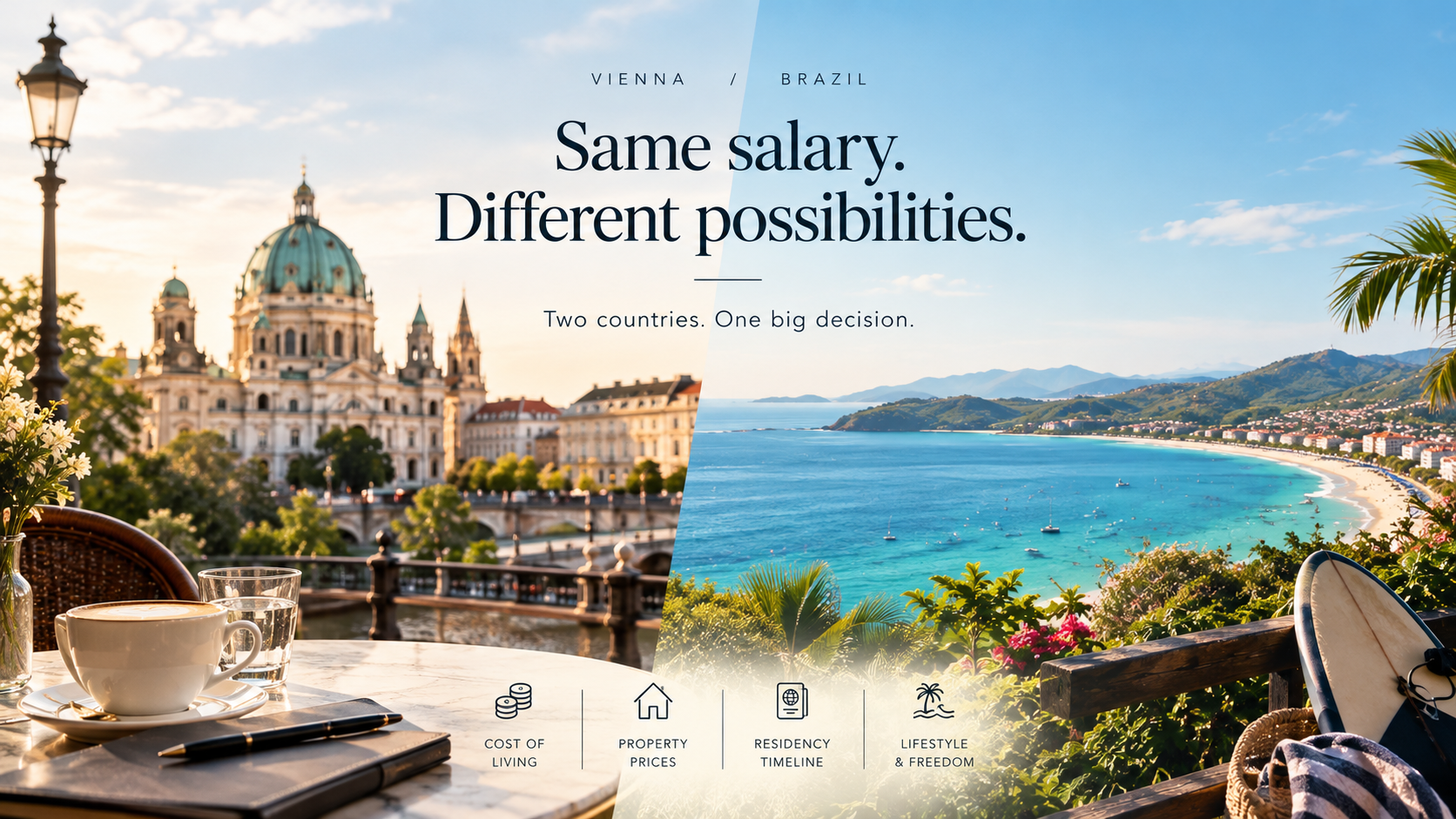
I am writing this from Vienna — ranked the world’s second most liveable city in 2026 by the Economist Intelligence Unit. And I live in Brazil. Here is why the numbers behind that choice matter for any European considering where to put their capital and their life.
Vienna is everything the rankings say it is. The public transport runs on time. The coffee is exceptional. The healthcare system works quietly and well. The streets feel almost theatrical in their cleanliness. Having grown up in Austria, I know this city intimately. It deserves its reputation.
And yet, when I look at where my capital has the most room to grow, where my purchasing power stretches furthest, and where I can build something in a market that has not yet been fully discovered — the answer keeps pointing back to Brazil.
This is not a criticism of Vienna. It is a comparison that I think every European investor and aspiring expat deserves to see laid out honestly.
The Rankings: What They Measure and What They Miss
The Economist Intelligence Unit’s Global Liveability Index rates 173 cities across stability, healthcare, culture, environment, education, and infrastructure. Vienna has sat at the top or near it for most of the past decade. In July 2026 it ranked second globally, behind only Copenhagen.
The InterNations Expat Insider 2026 survey measures something different: what it actually feels like to move somewhere as a foreigner. It surveys nearly 8,000 expats from 162 nationalities. Brazil ranked 5th globally in 2026, ahead of Spain, Portugal, Singapore, and Luxembourg.
One index measures city infrastructure. The other measures human experience. Both are worth understanding — and neither tells you what happens to your money.
The Cost of Living Gap
Brazil is approximately 39% cheaper than Austria overall based on the 2026 cost of living index. When you break that down by city, the difference is even more striking for coastal Brazilian markets that directly compete for the lifestyle-driven expat market.
What this means in practical terms: a European salary or pension that covers a comfortable but not extravagant life in Vienna provides a genuinely generous standard of living in Brazil’s coastal markets. The same €2,500 per month that covers rent, food, and transport in Vienna funds an expansive lifestyle in Búzios or Cabo Frio, with money left over to invest.
The Full Comparison: Vienna vs Brazil
| Category | 🇦🇹 Vienna / Austria | 🇧🇷 Brazil |
|---|---|---|
| Liveability ranking | #2 globally (EIU 2026) | #5 for expats (InterNations 2026) |
| Cost of living index | 70.8 (NYC = 100) | 33.1 ✓ |
| Path to permanent residency | 5 years | 2 years (via property) ✓ |
| Path to citizenship | 10 years | 4 years ✓ |
| Language requirement for residency | B1 German required | None at entry ✓ |
| Minimum property investment for residency | Not available via property | BRL 1M (~€170,000) ✓ |
| Average gross rental yield | 2.5% to 4% (Vienna) | 7.69% São Paulo Q1 2026 ✓ |
| House price growth trend | Moderate, market mature | 29 consecutive quarters of growth ✓ |
| Public healthcare | World class ✓ | Good in major cities, variable elsewhere |
| Safety | Consistently top ranked ✓ | Varies significantly by neighbourhood |
| Climate | 4 seasons, cold winters | Warm year-round on the coast ✓ |
The Investment Case: Where Vienna Cannot Compete
Vienna’s property market is mature, well-regulated, and expensive. Average gross rental yields in Vienna sit between 2.5% and 4%. Entry prices for a decent apartment in a central neighbourhood now regularly exceed €400,000. The capital appreciation story of the past decade has already played out. What remains is a stable, low-yield, high-entry-cost market — which is fine for preserving wealth, but limited for growing it.
Brazil’s coastal property markets sit at the opposite point in the cycle. House prices have risen for 29 consecutive quarters nationally. Gross rental yields in São Paulo averaged 7.69% in Q1 2026. In short-term rental markets along the coast, well-managed properties regularly exceed 8% to 10% annually.
The entry price for a qualifying investor visa property in the Southeast region — which covers Rio de Janeiro, Florianópolis, and the Região dos Lagos — is approximately BRL 1,000,000, currently around €170,000. That is less than half the cost of a comparable apartment in Vienna, with considerably stronger yield potential and a market still in its growth phase.
“One Lisbon apartment funds two in Brazil.” — A phrase I hear regularly from European investors who have done the comparison.
What Vienna Does Better
Honest comparisons acknowledge what each place does well. Vienna is not losing this comparison across the board.
Public healthcare
Austria’s universal healthcare system is among the best in the world. Brazil’s public system (SUS) is free but overstretched. Private healthcare in Brazil is affordable by European standards but requires insurance.
Safety and infrastructure
Vienna consistently ranks as one of the safest cities globally. Brazil’s safety record varies enormously by neighbourhood and city. Coastal tourist markets are generally much safer than major urban centres.
Bureaucratic efficiency
Austria’s public administration is reliable, predictable, and largely corruption-free. Brazil’s bureaucracy is notoriously slow and complex. Local guidance is essential for any property transaction.
EU membership benefits
Austrian residents enjoy full freedom of movement across the EU. Brazil offers a large domestic market and strong regional ties, but no equivalent multilateral framework for European passport holders.
Who Should Consider Brazil Over Vienna
This comparison is not for everyone. Brazil rewards people who approach it strategically, with local guidance and realistic expectations. It is particularly compelling for three profiles.
The first is the European investor looking for yield. If your capital is sitting in a European savings account earning 2% or less, or a Vienna buy-to-let generating 3%, Brazil’s coastal STR market offers a meaningfully better return at a lower entry price. The currency and complexity risks are real but manageable with the right structure.
The second is the early retiree or remote worker. If your income is in euros or dollars and you are no longer tied to a specific city for work, Brazil’s cost of living advantage is transformative. The same monthly income that provides a comfortable but unremarkable life in Vienna funds a genuinely expansive one on the Brazilian coast.
The third is anyone seeking residency or a second passport on a reasonable timeline. Brazil’s investor visa requires a property purchase of approximately €170,000 in the Southeast, two years of nominal presence, and leads to permanent residency. Citizenship follows after four years. Austria’s naturalisation process requires ten years of legal residence and B2 German language proficiency. The Brazilian pathway is faster, cheaper, and requires no language qualification at entry.
The Região dos Lagos: Where I Put My Own Answer
The Região dos Lagos — Búzios, Cabo Frio, and Arraial do Cabo — sits two hours south of Rio de Janeiro. It is where I am based, and it is where I see the Brazil opportunity most clearly.
Property prices here are still meaningfully below equivalent coastal markets in Europe, the Caribbean, or Southeast Asia. Short-term rental demand is strong and growing year-round, driven by both domestic Brazilian tourism and an increasing international visitor base. The landscape is genuinely extraordinary — crystalline lagoons, white sand beaches, and a climate that has no real off-season.
It is not Vienna. It does not have Vienna’s infrastructure, Vienna’s safety record, or Vienna’s coffee culture. What it has is space, warmth, a market still in early growth, and the kind of lifestyle that Europeans who visit once tend to return to permanently.
I help European investors and expats navigate this market on the ground. If the comparison in this article raises questions about what the numbers look like for your specific situation, the first conversation is free.
Curious about the Brazilian coastal market?
I offer free consultations for investors and expats exploring the Região dos Lagos. Based on the ground, fluent in German, French, English, and Portuguese.


Deixe um comentário