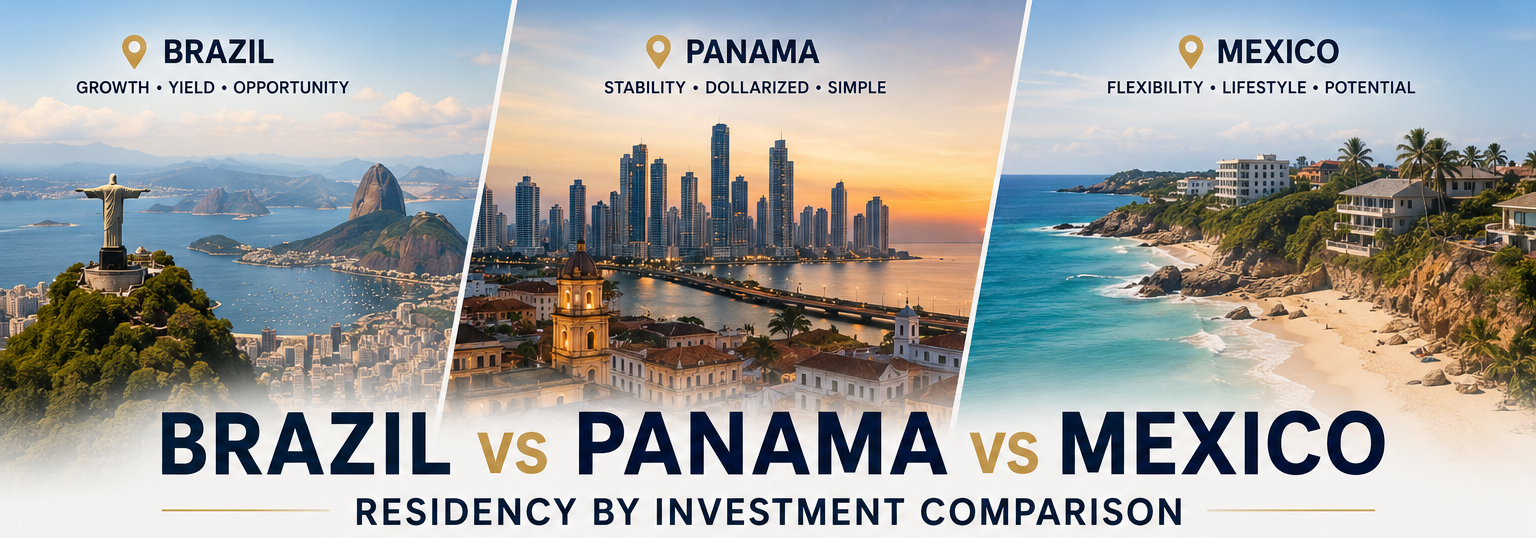
If you are exploring residency by investment in Latin America, three countries come up repeatedly in conversations with international investors: Brazil, Panama, and Mexico. Each offers a legitimate path to legal residency through a qualifying investment. But the structure of each program, and what your capital actually does beyond the visa, differs significantly.
This guide breaks down all three so you can make a genuinely informed comparison.
Why Latin America Is Attracting Global Investors Right Now
Latin America has moved from a secondary option to a primary destination for international investors and relocating professionals. The reasons are converging: favorable exchange rates against the euro and US dollar, strong rental yields compared to Western European markets, year-round warm climates, and residency programs that are more accessible than their European equivalents.
Brazil, Panama, and Mexico each sit at the top of that list for different reasons. Here is how they compare.
Brazil: Residency by Investment Through Real Estate (VIPER)
Brazil’s investor visa, officially known as VIPER, allows foreign nationals to obtain legal residency through a qualifying urban real estate purchase. No points system, no language test required at entry, and no requirement to live full-time in the country during the initial period.
Minimum investment thresholds:
North and Northeast regions (Fortaleza, Salvador, Recife, coastal Pipa): BRL 700,000, currently around $130,000 to $140,000 USD.
South, Southeast, East and Central regions (Rio de Janeiro, São Paulo, Florianópolis, Região dos Lagos): BRL 1,000,000, currently around $180,000 to $190,000 USD.
What the investment does beyond residency:
Brazil’s house price index has risen for 29 consecutive quarters as of Q1 2026. Gross rental yields average 7.69% in São Paulo and consistently outperform national averages in coastal short-term rental markets like the Região dos Lagos (Búzios, Cabo Frio, Arraial do Cabo). The Brazilian real has appreciated approximately 16% against the USD since early 2025, adding currency upside for dollar and euro holders who entered the market earlier.
The residency timeline:
You receive two-year temporary residency initially, with a minimum physical presence requirement of just 30 days during that period. After two years, provided you still own the qualifying property, you convert to Permanent Residency. Brazilian citizenship becomes available after four years of Permanent Residency, subject to a physical presence requirement of approximately nine months per year during that period.
Who this suits:
Investors who want their capital working as a real asset generating rental income. Those interested in a large, diverse country with a growing international community. Anyone considering a lifestyle base in one of the world’s most biodiverse and culturally rich destinations.
Panama: The Qualified Investor Visa
Panama has long been one of the most popular residency destinations in Latin America, and for good reason. It is politically stable, fully dollarised, has a low cost of living relative to North America and Europe, and its Qualified Investor Visa is well established and straightforward to navigate.
Minimum investment thresholds:
Real estate route: $300,000 USD minimum in qualifying property.
Securities route: $500,000 USD in securities listed on the Panama Stock Exchange.
Time deposit route: $750,000 USD in a Panamanian bank.
What the investment does beyond residency:
Panama’s real estate market in popular expat zones like Casco Viejo, Punta Pacifica, and Coronado is mature and well documented. Gross rental yields typically range from 4% to 6% in Panama City. Capital appreciation has been uneven in recent years. The dollarised economy removes currency risk but also removes currency upside for international investors holding euros or other currencies.
The residency timeline:
Panama offers one of the faster processing timelines in the region. Permanent Residency is granted directly without a temporary residency period first. There is no minimum physical presence requirement to maintain the residency, which suits investors who want optionality without commitment.
Who this suits:
Investors who prioritise stability, dollar-denominated assets, and a straightforward residency with no ongoing presence requirement. Those already operating businesses in the Americas who want a strategic base in a low-tax jurisdiction.
Mexico: Temporary and Permanent Residency Through Investment
Mexico does not have a single branded investor visa in the way Brazil and Panama do, but it offers a clear path to residency through financial solvency or real estate ownership that is widely used by international investors and remote workers.
Minimum investment thresholds:
Mexico’s residency through financial solvency is based on demonstrating sufficient income or savings rather than a fixed investment amount. As a general guide, Temporary Residency requires demonstrating a monthly income of approximately $2,600 USD or savings of around $43,000 USD. Permanent Residency requires demonstrating a monthly income of approximately $3,500 USD or savings of around $87,000 USD over the prior 12 months.
Real estate ownership can support a residency application but Mexico does not have a specific minimum property value tied directly to residency in the way Brazil and Panama do.
What the investment does beyond residency:
Mexico’s real estate market varies enormously by location. Tourist and expat markets like Tulum, Puerto Vallarta, Los Cabos, and Mexico City’s Roma and Condesa neighbourhoods have seen significant price appreciation over the past five years, driven partly by the remote work boom. Gross rental yields in premium tourist areas range from 6% to 10% for well-managed short-term rentals. The Mexican peso has shown volatility against the dollar, which creates both risk and opportunity for foreign investors.
The residency timeline:
Temporary Residency is granted for one to four years and can be converted to Permanent Residency after four years of continuous temporary residency. There is no citizenship pathway through investment alone. Naturalisation requires five years of legal residency and Spanish language proficiency.
Who this suits:
Investors who want proximity to the United States, a large and diverse domestic market, and strong STR income potential in established tourist destinations. Those who prefer a more flexible entry threshold based on income rather than a fixed investment amount.
Side by Side: Brazil, Panama, and Mexico
The three programs serve genuinely different investor profiles. Here is the core comparison:
Brazil offers the lowest entry cost for a formal investor visa in the Southeast region at around $185,000 USD, strong rental yield potential, 29 consecutive quarters of house price growth, currency upside, and a pathway to one of Latin America’s most powerful passports. The trade-off is a larger country that requires more local knowledge to navigate well and a bureaucratic process that benefits from experienced on-the-ground guidance.
Panama offers dollarised stability, no minimum presence requirement, and a mature expat infrastructure. The trade-off is a higher entry cost at $300,000 USD minimum and more modest yield potential in a market that is already well discovered.
Mexico offers flexibility in how you qualify, strong STR yields in the right markets, and North American proximity. The trade-off is that the residency pathway is less directly tied to a specific investment and currency volatility adds a layer of complexity.
The Question That Matters Most
Before choosing a program, the most important question is not which country has the lowest entry threshold. It is what your capital does beyond the visa.
Can the investment generate income from day one? What does the market look like in five years? Does the investment still make sense if you never use the residency? How much control do you have over the asset?
Residency is one part of the equation. The investment itself deserves equal attention.
Exploring Brazil’s Coastal Market on the Ground
I am based in the Região dos Lagos, one of Brazil’s strongest short-term rental markets, and I work with international investors navigating the Brazilian property market from the first question to the first booking.
If you are considering Brazil as part of your international strategy and want to understand what the market looks like on the ground, I am happy to talk.
Book a free consultation or send a message directly on WhatsApp.

This article is for informational purposes only and does not constitute legal or tax advice. Investment thresholds and program requirements are subject to change. Always consult a qualified lawyer and financial advisor before making investment decisions.